
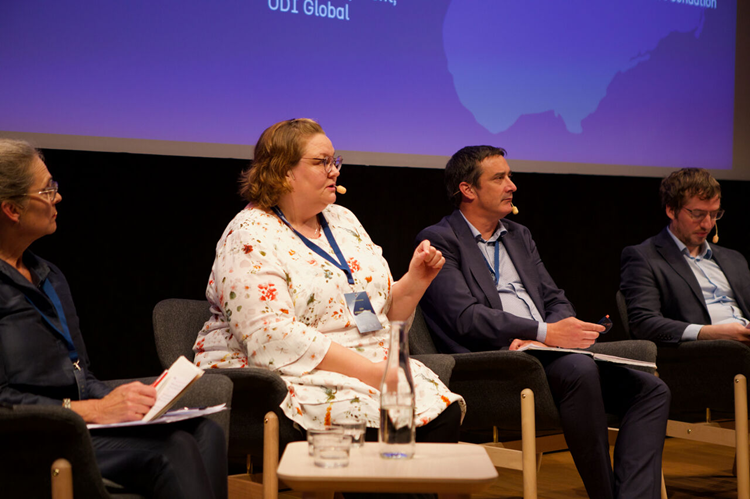
Earlier this week, I joined the From Depth to Action forum in Stockholm, the opening event of the 6th UN Ocean Decade Foundations Dialogue, convened by Voice of the Ocean Foundation and IOC-UNESCO.
I took part in a panel on strengthening partnerships around ocean observations, alongside representatives from science, philanthropy, industry and the wider Ocean Decade community.
My contribution focused on a deceptively simple question: how should we finance the ocean-observing systems on which science, public policy and an increasing range of commercial decisions depend?
Ocean observing is infrastructure
My starting point was that ocean observing should increasingly be understood as public-good and enabling infrastructure.
Observing systems help us understand the state of the ocean, improve climate and weather forecasting, monitor biodiversity, strengthen early-warning systems and support marine planning. But they also increasingly underpin commercial decisions in sectors ranging from offshore wind and shipping to aquaculture and insurance.
That matters for financing.
Too often, discussions begin with an identified funding gap and jump straight to the question of how to “mobilise private capital”. But much of the foundational ocean-observing system has the characteristics of a public good: its benefits are diffuse, long-term and shared widely across society. There may be no obvious commercial actor able to capture enough of that value to justify paying for the system as a whole.
In those cases, sustained public finance is not a failure of financial innovation; it is the appropriate financing model.
The more useful question is therefore not whether ocean observations can somehow be made universally “investable”, but which parts of the system create identifiable value for particular users, and which type of capital is best suited to financing each part.
Follow the full data value chain
One way of approaching this is to look across the full data value chain:
observation → processing → distribution → uptake
At the observation stage, this may mean buoys, sensors, gliders, satellites, acoustic monitoring or seabed surveys.
Processing turns those raw observations into usable information through quality control, modelling and analysis.
Distribution brings that information to users through platforms, APIs, forecasts or decision-support tools.
And uptake is where the information actually influences a decision: where to site an offshore wind farm, when a port can safely operate, how an insurer assesses coastal risk, or whether an operator needs to change maintenance plans.
The closer information gets to a specific commercial decision, the easier it often becomes to identify a commercial user—and therefore a potential payer.
That distinction is important. A company may have little incentive to finance a global observing network, but it may be entirely rational for it to pay for additional observations, higher-resolution analytics or decision-specific services that reduce its costs or risks.
Where commercial finance already makes sense
There are already strong examples.
Offshore wind developers routinely pay for wind, wave, current and seabed data because those observations affect siting, engineering, installation and operations. Biodiversity commitments can create additional demand for monitoring: Ørsted’s blue-bond framework, for example, includes research and monitoring linked to offshore biodiversity.
Ports and shipping companies have similarly direct incentives to pay for better forecasting when it reduces downtime, improves route planning or increases operational safety.
Aquaculture companies monitor temperature, oxygen, salinity and other environmental conditions because those variables directly affect fish health and production.
Insurance and reinsurance provide a slightly different example. Here, commercial willingness to pay is often strongest further downstream—for risk models, analytics and decision-support services built on underlying public observations.
The important point is that having economic value is not the same thing as having a revenue model. A societal benefit may be very large while still requiring public funding. Private finance becomes relevant where there is a user with both a clear benefit and a credible mechanism through which that value can be captured.
Different capital, different roles
That leads to a relatively simple division of labour.
Public finance should sustain the foundational observing system and other genuinely public-good functions.
Philanthropic capital can be particularly valuable in taking early risks, funding innovation, improving interoperability, connecting data producers with users and demonstrating new applications.
Commercial users can finance additional observations, analytics and services where these directly improve operational, regulatory or financial decisions.
And private investors can finance the companies and assets that provide those services once there are sufficiently predictable customers and revenues.
This is why corporate expenditure can sometimes matter more than a complex financial instrument. An offshore wind developer procuring a long-term monitoring service, or a port paying for operational forecasting, is already private money supporting the ocean-data ecosystem.
From mobilisation to impact
A recurring theme in my work at ODI Global’s Centre for Private Finance in Development is the need to move from mobilisation to impact.
The same principle applies here.
The objective should not be to maximise the amount of private capital associated with ocean observations. It should be to build a resilient observing system, close important geographic gaps, ensure data are usable and accessible, and ultimately improve decisions and outcomes.
That is especially important for small island developing states and other vulnerable countries. These are often places where the societal value of better ocean information is greatest, but fiscal capacity and commercial willingness to pay may be weakest. A purely market-led allocation of observing capacity could therefore produce exactly the wrong outcome.
A practical next step
For the final question of the panel, I suggested a practical experiment for the coming year: develop a small portfolio of user-led financing pilots around three or four very different use cases.
These might include offshore wind and biodiversity monitoring; insurance and coastal risk; ports and shipping; and a SIDS resilience application.
For each, the process would be the same: map the full chain from observation to decision, identify who benefits, establish who captures value, and test which combination of public, philanthropic and private finance is most appropriate.
Importantly, the purpose would not be to prove that private finance works everywhere.
It would be to establish where it works, where it does not, and what role each form of capital should play.
That, ultimately, is the financing question that matters.