
The blue economy is often discussed as a new source of technologies and investment opportunities. For many companies, a better starting point is much closer to home: understanding where their existing business already depends on the ocean.
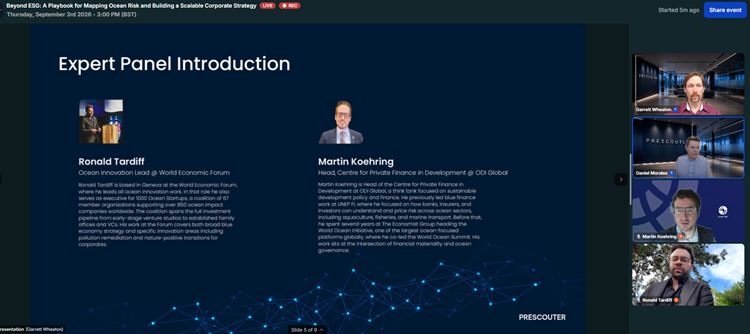
I recently joined Ronald Tardiff of the World Economic Forum for a PreScouter webinar on how companies can move beyond broad ESG commitments and build practical strategies around ocean-related risks and opportunities.
A central theme of our discussion was that companies do not need to consider themselves part of the “blue economy” to have meaningful exposure to the ocean.
The challenge is to identify that exposure, determine where it is financially material, and then decide what—if anything—the company should do about it.
Start with the business, not with the ocean
Much of the traditional blue-economy conversation starts with sectors: fisheries, shipping, ports, offshore energy or aquaculture.
That framing is useful, but it can also create a blind spot. A consumer-goods company, retailer or manufacturer headquartered hundreds of kilometres from the coast may reasonably conclude that the ocean is peripheral to its business.
Financial exposure does not follow those sector boundaries.
A landlocked manufacturer may rely on components transported through major ports and maritime chokepoints. A cosmetics or food company may use marine-derived ingredients. A consumer-goods company may face pollution or regulatory exposure through packaging. Companies may also depend indirectly on coastal suppliers, fisheries or marine ecosystems much further down their value chains.
Those dependencies rarely appear in financial statements labelled “ocean risk”. Instead, they materialise as higher input prices, disrupted supply, increased operating costs, regulatory requirements, liabilities or lost revenues.
That suggests a different starting question.
Rather than asking, “Are we an ocean company?”, executives should ask:
Where do our revenues, costs, assets, supply chains and liabilities depend on ocean systems?
Materiality can also work in both directions. A vulnerable dependency may represent downside risk, but it can simultaneously reveal an opportunity to secure scarce supply, develop a differentiated product or build strategic capability before competitors do.
Map exposure before choosing investments
Once those dependencies become visible, the temptation is often to jump directly to solutions: an ocean fund, a new technology, a sustainability initiative or a pilot.
That reverses the right sequence.
A useful assessment can start with four steps.
First, map dependencies across raw materials, suppliers, logistics, physical assets, products and regulatory touchpoints.
Second, identify the financial transmission mechanism. Could an ocean-related dependency affect input costs, continuity of supply, market access, liabilities, asset values or revenues?
Third, prioritise by materiality. Not every ocean-related issue warrants the same attention. Companies need to consider magnitude, likelihood and time horizon, alongside their own ability to influence the outcome.
Finally, decide on the appropriate strategic response. That might involve diversifying supply, changing procurement, investing upstream, partnering with another organisation, transferring risk or simply monitoring an issue that is not yet sufficiently material.
The output should therefore be a prioritised map of business exposure and opportunity—not a catalogue of blue-economy investments.
Investment opportunities should emerge from the diagnosis rather than precede it.
Let the instrument follow the strategy
The same principle applies to finance.
The blue-finance debate can sometimes begin with instruments: blue bonds, investment funds, blended finance or other labelled products.
But the better question is what business problem the company is actually trying to solve.
If the objective is supply security, an offtake agreement, supplier finance or a joint development agreement may be more useful than a passive investment.
If the company wants access to an emerging technology, strategic equity or a corporate venture investment might provide valuable optionality.
If an underlying project is commercially viable but one particular risk prevents capital from flowing, a guarantee or other risk-sharing mechanism may help.
And where an investment creates significant public benefits that are not captured in commercial returns, blended finance may have a role.
Sometimes the appropriate response is not a financial instrument at all. Better traceability, procurement reform, internal capability or a strategic partnership may solve the underlying problem more effectively.
The principle is simple:
The strategy should follow the exposure, and the instrument should follow the strategy.
Blue finance should not start with the colour of the instrument. It should start with the business dependency the company is trying to protect or scale.
A successful pilot is not yet a scalable business
Another major theme of the discussion was the difficulty of moving ocean innovation from pilots into mainstream commercial operations.
Technical feasibility is only one part of that journey.
A startup may successfully demonstrate a new ingredient, material or technology at relatively low volume. But supplying a multinational can require an entirely different level of production capacity, working capital, certification, quality assurance and supply-chain infrastructure.
That creates a scale-up financing problem.
The supplier may not have the balance sheet to finance expansion, while the corporate customer may be unwilling to assume all of the risk.
This is where demand certainty can become a form of de-risking.
A credible long-term procurement commitment or offtake agreement can help a supplier demonstrate future revenues and attract the capital required to expand. Strategic equity, supplier finance, joint development agreements or guarantees can then address other elements of the financing gap.
But capital alone is not enough.
Unit economics need to work. Standards and regulation need sufficient clarity. Procurement has to be involved. And internal incentives must align.
If R&D values technical performance, sustainability values environmental impact, procurement is rewarded primarily for short-term cost and reliability, and finance focuses on return on capital, an initiative can easily stall despite a successful pilot.
Scaling therefore requires alignment across technology, economics, capital, demand, procurement and organisational incentives.
A technically successful pilot is not yet a commercially successful innovation.
The ultimate goal is integration
Looking ahead, one sign of progress may actually be that companies talk less about having a separate “ocean strategy”.
Instead, ocean-related dependencies would increasingly become ordinary inputs into procurement, risk management, capital expenditure, innovation and investment decisions.
That is similar to the trajectory we have already seen with climate considerations: moving gradually from specialist sustainability teams towards mainstream corporate decision-making.
Companies would know where their most important ocean dependencies lie. They would have clearer thresholds for determining financial materiality. And they would have established processes for deciding when to mitigate risk, invest, partner or monitor.
Most importantly, they would move from individual pilots towards repeatable models for taking promising ideas from exposure assessment through procurement and financing to commercial scale.
The objective is not simply to create more blue initiatives.
It is to integrate ocean considerations into the way companies already allocate resources, manage risk and build long-term resilience.
Further reading: Explore PreScouter’s Blue Economy hub, including the decision brief Making Sense of the Blue Economy, developed with input from the expert panel.