
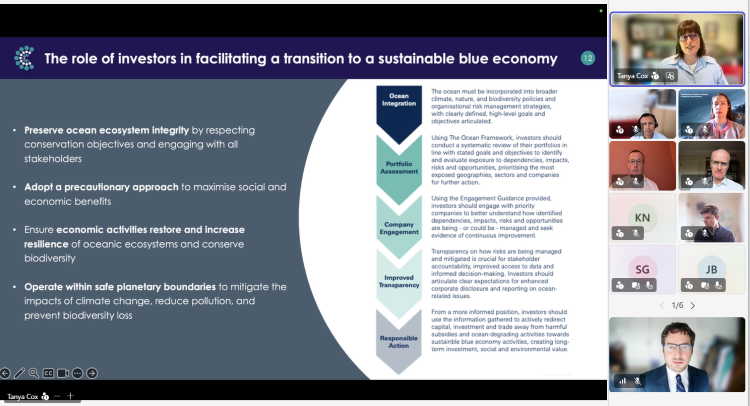
On World Ocean Day, I was pleased to contribute to a webinar launching The Ocean Framework: An Investor Guide to Navigating Ocean Risks and Opportunities, developed by Chronos Sustainability in partnership with the First Sentier MUFG Sustainable Investment Institute.
I reviewed the Framework in draft form and joined the launch discussion alongside experts working across sustainable finance, ocean science, disclosure, stewardship and blue finance. The recording is available here.
The ocean is not a niche ESG issue
The central message of the discussion was clear: the ocean can no longer be treated as a niche environmental or ESG issue. It belongs in mainstream investment decision-making.
The ocean underpins climate regulation, food security, global trade, coastal infrastructure, livelihoods and biodiversity. It is also increasingly relevant to how investors think about long-term value creation, systemic risk and resilience. Ocean degradation can translate into financially material risks through supply chain disruption, physical asset exposure, regulatory change, reputational risk, litigation and the loss of critical ecosystem services.
A sustainable blue economy needs guardrails
The transition to a sustainable blue economy creates opportunities: in sustainable seafood, maritime decarbonisation, coastal resilience, offshore renewable energy, nature-based solutions and improved ocean data and monitoring.
But these opportunities need to be approached carefully. Not all “blue economy” investment is automatically sustainable. Strong safeguards, credible data, community engagement and measurable outcomes are essential.
From awareness to action
This is where The Ocean Framework makes a useful contribution. It helps investors move from general awareness to practical action by providing a structured way to identify ocean-related exposure, assess impacts and dependencies, prioritise sectors and companies, and engage more effectively with portfolio companies.
The investability challenge
From an ODI Global and Centre for Private Finance in Development perspective, I am particularly interested in what comes next: how we move from ocean awareness to investable pathways that support resilience, food security, sustainable infrastructure and ecosystem restoration, especially in coastal and ocean-dependent economies.
One of the biggest barriers is not simply lack of capital. It is investability. Many ocean-positive opportunities remain small, early-stage, fragmented, data-poor or dependent on enabling policy environments. Mobilising private capital at scale will require stronger project pipelines, better risk-sharing, public finance, development finance, guarantees, aggregation mechanisms and credible impact measurement.
A transition and development agenda
The sustainable blue economy should therefore be understood not only as an investment theme, but as a transition and development agenda. The challenge is to mobilise the right kind of capital: capital that supports long-term resilience, avoids harm, delivers measurable development outcomes and helps restore the ocean systems on which people, economies and investors depend.