
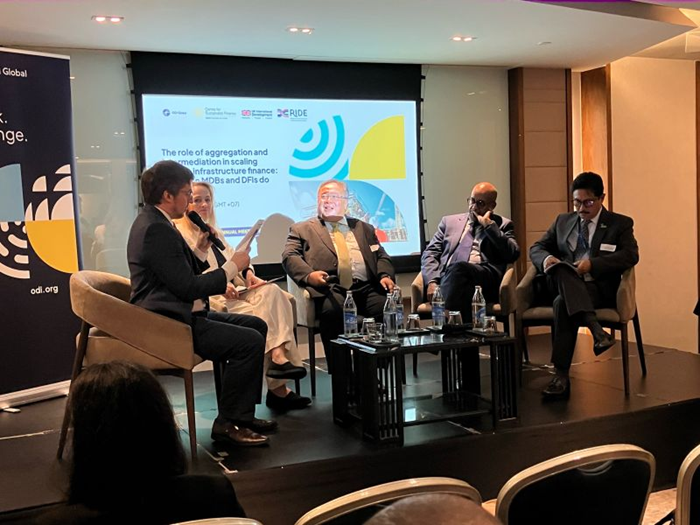
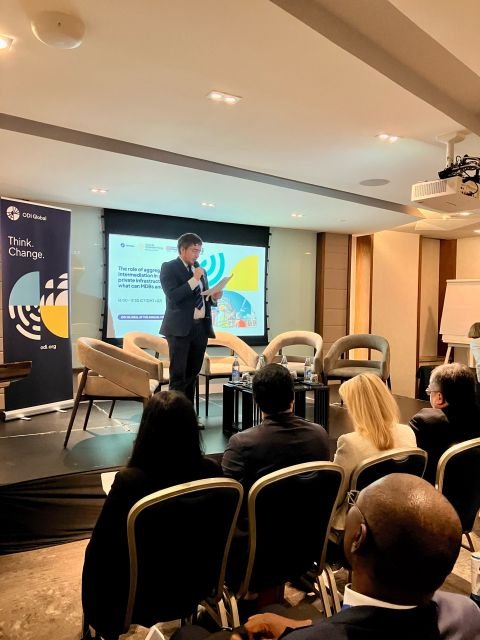
At ODI Global Day during the October 2026 IMF–World Bank Annual Meetings in Bangkok, I had the pleasure of moderating a discussion on scaling private infrastructure finance, jointly organised by ODI Global and the SOAS Centre for Sustainable Finance.
Drawing on emerging research from our UK-funded MPF-Infra programme, we explored how multilateral development banks (MDBs), development finance institutions (DFIs) and domestic institutions can move beyond financing individual projects towards creating markets that attract private investment at scale.
Our discussion brought together research presented by ODI Global’s Judith Tyson and SOAS’s Ulrich Volz, alongside perspectives from the Asian Development Bank Institute, TDB Group, PT Sarana Multi Infrastruktur and institutional investor ILX.
One key message stood out: aggregating infrastructure investments into larger, diversified portfolios can help attract institutional capital, but cannot make fundamentally unviable projects bankable. Stronger project preparation, domestic intermediation and effective risk allocation remain essential.
Rethinking MDB business models
These themes resonated throughout the week.
At a roundtable co-hosted by ODI Global, the Rockefeller Foundation, the Children’s Investment Fund Foundation and the Gates Foundation, discussions focused on how MDB private-sector operations could evolve to mobilise more investment and support market creation.
Beyond traditional lending, instruments such as guarantees, equity, securitisation and originate-to-share approaches offer opportunities to attract institutional investors and make more effective use of MDB balance sheets.
A separate discussion hosted by the Center for Global Development and ICRIER, featuring new joint research from ODI Global and partners, reinforced the need to translate expanded MDB lending capacity into stronger investment pipelines and development impact.
Better risk data, better investment decisions
Other discussions on prudential regulation and emerging-market investment data highlighted the importance of improving how investment risks are understood and recognised.
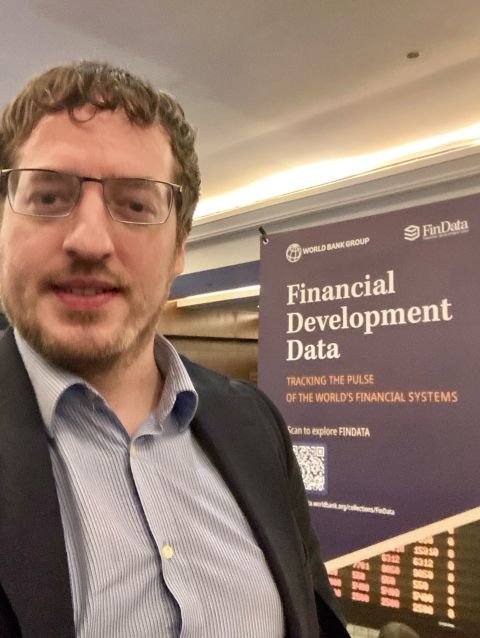
Initiatives such as EMInvest and the Global Emerging Markets Risk Database (GEMs) can help address gaps between perceived and actual investment risks. Meanwhile, the World Bank’s launch of its Financial Development Data (FinData) highlighted persistent gaps in financial-system depth and access, particularly in developing economies.
But better data alone will not necessarily change investor behaviour or financing conditions. The challenge is to translate improved evidence into more appropriate risk pricing, better investment decisions, stronger domestic financial markets and ultimately greater development impact.
Building domestic investment ecosystems
At a roundtable convened by Jain Family Institute Social Wealth and partners, we explored how sovereign wealth funds, national development banks and development financiers can collaborate to strengthen domestic investment ecosystems.
These conversations reinforced a central lesson from Bangkok: mobilising private capital is not an end in itself. The real test is whether public finance interventions help build sustainable markets, strengthen institutions and generate lasting development outcomes.
This is at the heart of the work we are advancing through ODI Global’s Centre for Private Finance in Development.
Further reading: